
Hi Zee. What Was Onboarding Like at Your Last Job?

Hopefully, it didn’t feel like: "Welcome to the team. Here’s your laptop. Good luck." (Unfortunately, that sounds pretty standard these days)
Dear Zee, first impressions are everything, right?
You wouldn’t go on a first date without putting in some effort. You’re thoughtful about the venue, your outfit and the conversation. In the workplace, when companies are swooning a potential new client, they go all out… glossy presentations, thoughtful follow-ups, fancy lunches and red-carpet treatment.
So tell me this… why is it so painfully normal for companies to treat new employees like an administrative afterthought the second the contract is signed?
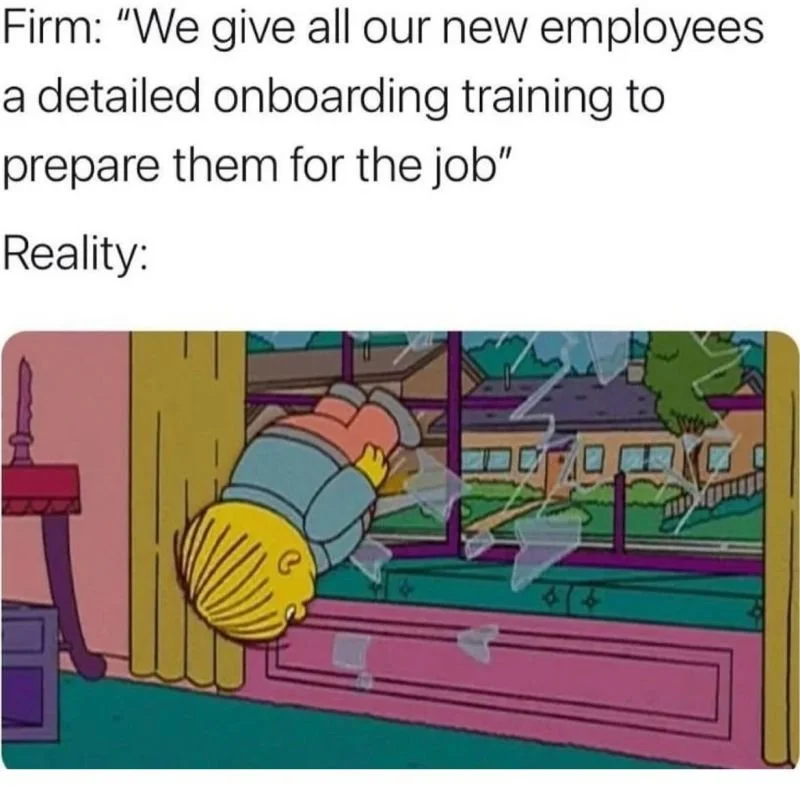
I was having dinner with a friend last week. She had just started a new job she was wildly excited about. It’s a great step forward in her career, closer to home and has great perks. The company had spent weeks courting her. They interviewed her, checked her references and put on the full charm to convince her she was the exact right fit. And then, on her first day, she didn’t have a desk. Or a computer. She finally got a laptop at the end of week one. But by week two? She was literally in the office building her own desk. The supreme irony here is that she was hired as a case worker for disabled adults… an industry literally built around human care and compassion. Yet, the organization treated their own new hire like an inconvenience that accidentally showed up on a Monday. What. The. Hell.
Of course, I had to take this to Threads to see if my friend’s story was just an isolated nightmare or part of a systemic pattern. The replies were actually a bit more alarming that I expected. It turns out that dropping new hires into an absolute free-for-all isn't the exception… it's more like a standard operating procedure.
People shared stories of walking into their new jobs only to find a desk piled high with someone else's old paperwork… including, in one memorable instance, a loose Xanax sitting on the keyboard, which was a pretty massive clue about the company culture. Supervisors chimed in to confess the deep embarrassment of having a new hire show up at their desk when nobody told them a hire was even made, leaving them scrambling for working Wi-Fi and missing logins. Another person recalled being labeled "bitchy" by HR simply for opening an IT ticket after the company spelled her name wrong in her official email address and took six weeks to fix it, effectively locking her out of Teams and shared drives. From managers going on maternity leave without leaving a single handoff note, to taking six months just to get basic server access, the consensus was overwhelming… most people have never experienced a real, intentional onboarding process. They are simply dumped at a desk, while the people who hired them vanish and expect miracles.
The Unforgivable Math of Bad Onboarding
Having spent years in the agency world, I lost count of how many times I watched onboarding become a last-minute scramble. IT wouldn't be notified, the manager would be booked solid in back-to-back meetings and the new hire would spend their first week getting passed around the office like a hot potato, talking to whoever had 10 minutes of capacity. By Friday, they’ve met 30 people, learned almost nothing about their actual job, and are already apologizing for asking "too many questions." A month later, leadership quietly wonders why they aren't "getting it quickly enough."
We spend thousands of dollars talking about finding the "perfect candidate," but almost zero time asking whether we’ve built an environment where a human can actually succeed.
Once again, I’m not making this shit up. The data is pretty wild:
Only 12% of employees strongly agree their company does a good job of onboarding. That means 88% of the global workforce is dropped into an operational disaster on Day One. (Again I have to ask… WHY!!??)
Up to 30% of new hires quit within the first 90 days. They don't leave because they suddenly forgot how to do their job… they leave because their first impression was surviving instead of belonging.
The financial burn is massive. Studies show replacing a worker costs between 6 to 9 months of their salary when you factor in recruitment, lost productivity and administrative overhead.
Dropping a new hire into chaos isn't just bad culture, it’s actually gross financial negligence. The most expensive onboarding program is the one you never built, because every hour a new employee spends wandering around trying to figure out how things work is money flushed straight down the drain.
And I think that’s the part of this mess we wildly underestimate. The supervisor or manager sitting across from that new hire is often being held responsible for a system they don’t actually have any control over. They didn't delay the IT ticket, they didn't set up the HR portal and they didn't design the siloed handoff. Unfortunately though, they are the ones left apologizing while trying to keep their own workload afloat.
"Drinking From the Firehose" Is Not a Strategy
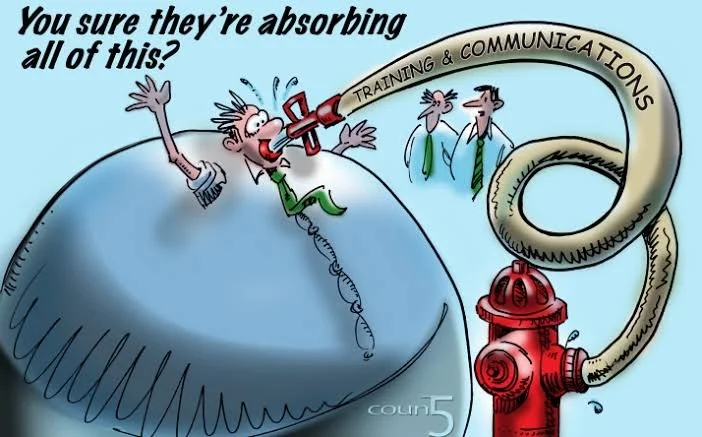
We’ve accepted some really strange ideas about what "good onboarding" looks like. For some reason, corporate culture has normalized phrases like "It’s like drinking from a firehose!" as if drowning someone in 40 hours of unorganized Slack channels, compliance videos and HR portals is a badge of honour. Imagine saying that about literally any other learning experience. Information overload isn't onboarding. It's a hazing ritual.
Most onboarding is designed entirely around compliance and what the company needs:
Payroll forms.
Software licenses.
Security protocols.
Reading through dusty SOPs.
Is it necessary? For sure. But more importantly, is it sufficient? Not even close.
Almost none of it is designed around the person. We force people to consume information like a machine, rather than building a two-way relationship. When someone spends their first three months lost and confused, they don't make good decisions. They make mistakes, redo work and burn all their cognitive energy trying to navigate office politics instead of actually contributing.
So Why Are Companies So Terrible at Onboarding?
When you strip away the corporate buzzwords, the breakdown usually comes down to a complete lack of a standardized workflow, zero accountability for the people doing the hiring and the uncomfortable truth that HR is often missing or completely siloed when it comes to actual operational execution.
Having analyzed these systems for years, here is where I think the system (or lack of a system) completely falls apart:
The HR vs. Ops ownership gap: Recruiting is viewed as HR’s job, while daily performance belongs to Operations. Onboarding sits awkwardly in the messy middle and when a critical business process belongs to "everyone," it effectively belongs to no one.
The "handoff" anomaly: Talent acquisition teams are often incentivized solely on getting an offer letter signed. The moment the candidate says "yes," HR considers their job done, throws the new hire over the fence into Operations, and immediately moves on to the next requisition.
Pure role confusion: The direct manager assumes IT has the laptop and software logins prepped. IT assumes HR gave the new hire their schedule and ramp-up plan. HR assumes the team is taking care of the day-to-day integration. Nobody owns the end-to-end experience, so the new hire pays the price.
Treating it as administration, not integration: Most onboarding workflows are designed entirely around what the company needs to cover its ass—compliance forms, tax documents, and NDA signatures. Almost zero thought is given to what the human needs to actually understand the business, build relationships, and succeed in their role.
When an organization doesn't have an established, cross-functional workflow with clearly assigned responsibilities, onboarding will always default to a last-minute scramble.
Let’s Make Onboarding a Conversation, Not a Complete Overload
What if onboarding looked completely different? What if the first 90 days were designed around creating mutual understanding instead of forcing someone to "prove themselves" under unfamiliar conditions?
If a company spends thousands of dollars recruiting you, Zee, they should be spending the first month learning about you:
How do you do your best work?
What communication style helps you thrive?
What specific experiences and perspectives are you bringing that can make our systems better?
And on the flip side, you deserve clarity from them:
Why does this work actually matter?
How does your role connect to the company's broader strategy?
What does success actually look like here after 30, 60, and 90 days?
Sustainable workplaces don’t start with carbon credits or recycling bins in the lunchroom. They have to start with designing onboarding systems that stop consuming people the moment they walk through the door. Maybe the first question a manager asks a new hire shouldn't be, "Did you sign the IT policy?" Maybe it should be: "Who are you, and what do you need from us to do your best work?"
Until organizations stop confusing administrative checklists with human integration, they will keep wondering why their "perfect hires" keep walking out the door.